
You know the feeling. You hit the snooze button. You reach for the cookie. You promise yourself you'll start tomorrow. Again. What if the problem isn't your motivation, but your wiring? The truth is, your brain was never designed to handle endless temptation and instant gratification. But the good news? Science has unlocked exactly how self-discipline neuroscience works — and you can use it to rewire yourself for lasting change.
Let’s dive into the machinery behind willpower, habit formation, and the remarkable plasticity of your brain. By the end, you’ll understand why some habits stick and others crumble — and what you can do to tip the scales in your favour.

Table of Contents
What Is Self-Discipline Neuroscience?
Self-discipline neuroscience sits at the intersection of psychology, behavioural science, and brain imaging. It examines what happens inside your skull when you resist a craving, form a new habit, or push through discomfort to achieve a goal.
Every decision you make starts as a neural signal. Your prefrontal cortex — the CEO of your brain — evaluates options, weighs long-term outcomes, and sends commands to your motor systems. But it’s not alone. Your limbic system, powered by dopamine, constantly shouts for immediate rewards. The battle between these systems is the biological root of willpower.
Understanding this inner tug-of-war is the first step to mastering it. And the research is clear: willpower isn’t a fixed trait. It’s a skill you can train, just like a muscle.
The Brain's Habit Formation System
Habits live in a different part of your brain than conscious decision-making. They’re stored in the basal ganglia, a primitive region responsible for automating repeated actions. Once a behaviour becomes a habit, your prefrontal cortex can step back and let the autopilot take over.
The Habit Loop: Cue → Routine → Reward
Charles Duhigg popularised this three-part cycle in The Power of Habit. Here’s how it works:
- Cue: A trigger that tells your brain to go into automatic mode. It could be a time of day, a location, an emotion, or a preceding action.
- Routine: The behaviour itself — physical, mental, or emotional.
- Reward: A positive stimulus that reinforces the loop. Dopamine is released, making you want to repeat the routine when you see the cue again.
Every habit you have — from tying your shoes to checking your phone — follows this loop. The stronger the neural pathway, the more automatic the behaviour.
| Component | Example (Bad Habit) | Example (Good Habit) |
|---|---|---|
| Cue | 3 PM slump at work | Morning alarm |
| Routine | Grab a candy bar | 5-minute meditation |
| Reward | Sugar spike + relief | Calm + focus |
Self-discipline neuroscience shows that you can rewire any loop. You don’t need to eliminate the cue or the reward — just swap the routine.
The Role of the Prefrontal Cortex in Willpower
Your prefrontal cortex (PFC) is the conductor of this neural orchestra. It handles goal-setting, planning, impulse inhibition, and long-term thinking. When you say “no” to dessert or push through a tough workout, your PFC is doing the heavy lifting.
But the PFC runs on glucose and oxygen. When you’re tired, stressed, or depleted, its activity drops. That’s why willpower fades as the day goes on. Research from Roy Baumeister’s lab showed that people who exert self-control on one task perform worse on the next, a phenomenon called ego depletion.
However, self-discipline neuroscience has also revealed that the PFC grows stronger with repeated use. Neuroplasticity — your brain’s ability to form new connections — means that every act of discipline physically thickens the neural pathways in your PFC. You’re literally building willpower tissue.
How Dopamine Drives or Distracts Us
Dopamine is often called the “pleasure chemical,” but that’s misleading. It’s actually the anticipation chemical. It spikes when you expect a reward, not when you get it.
This is why your phone feels irresistible. Every notification is a potential cue with an uncertain reward — a text, a like, a new email. Your brain releases dopamine just thinking about checking it. That anticipation overrides your PFC and pulls you into the loop.
Self-discipline neuroscience offers a solution: consciously reduce the uncertainty and the reward value of distractions. For example, turning off notifications or keeping your phone in another room lowers the dopamine hit, making it easier to stay focused.
What Changes in the Brain When You Practice Self-Discipline?
When you consistently exercise self-control, real structural and functional changes occur:
- Increased grey matter in the prefrontal cortex. Studies on long-term meditators show thicker PFC regions.
- Stronger connectivity between the PFC and the basal ganglia. This means your conscious goals have more influence over your automatic habits.
- Reduced activity in the amygdala, the brain’s fear centre. Self-discipline lowers emotional reactivity, helping you stay calm under pressure.
- Improved glucose efficiency in the brain. Over time, your brain learns to use energy more sparingly during demanding tasks.
These changes don’t happen overnight. But they are measurable after just a few weeks of consistent practice. That’s the power of neuroplasticity.
The Science of Willpower Depletion
For decades, researchers believed willpower was a finite resource that drained over time. The famous “radish and chocolate” experiment illustrated this: people who resisted radishes gave up faster on a subsequent puzzle than those who ate chocolate.
But newer research complicates this picture. Some studies find that beliefs about willpower matter as much as the biology. If you think your willpower is unlimited, you perform better and deplete less.
What’s actually happening? The brain’s anterior cingulate cortex detects conflict between goals and impulses. When the conflict is high, the PFC works harder and uses more energy. Over time, this leads to mental fatigue.
To counteract depletion, self-discipline neuroscience recommends:
- Strategic breaks to restore glucose and oxygen to the brain.
- Small wins that build momentum without draining resources.
- Automaticity — turning discipline into habit so it requires less conscious effort.
Practical Strategies Based on Neuroscience
Knowing how your brain works is half the battle. Here are actionable techniques rooted in self-discipline neuroscience:
1. Implementation Intentions
Formulate “if-then” plans. For example: “If it’s 7 AM, then I will run for 20 minutes.” This offloads decision-making to your basal ganglia, reducing the load on your PFC.
2. Environmental Design
Make good habits easier and bad habits harder. If you want to eat healthier, keep fruit on the counter and junk food in a high cupboard. Your brain will follow the path of least resistance.
3. Habit Stacking
Attach a new habit to an existing one. After you brush your teeth, do one push-up. The existing cue fires, and the new routine piggybacks on the old neural pathway.
4. Dopamine Detox
Periodically remove high-dopamine triggers (social media, junk food, video games) for 24–48 hours. This resets your reward sensitivity and makes lower-value tasks feel more satisfying.

| Strategy | Brain Area Targeted | How It Helps |
|---|---|---|
| Implementation Intentions | Prefrontal cortex, basal ganglia | Automates decisions |
| Environmental Design | Limbic system | Reduces temptation signals |
| Habit Stacking | Basal ganglia | Builds on existing loops |
| Dopamine Detox | Reward system | Resets motivation |
Recommended Resources for Deepening Your Understanding
Several books dive deeper into the science and practice of self-discipline. Below is a comparison of five powerful resources you can pick up today.
| Product | Price | Rating | Why It Helps | Buy at Amazon |
|---|---|---|---|---|
|
$12.93 | 4.7 | Jocko Willink’s raw, no-excuses field manual for mental toughness | Buy Now |
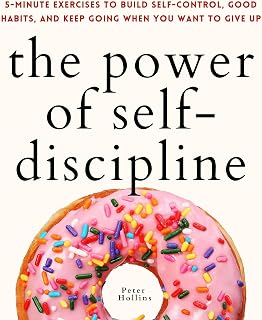 |
$0.00 (audible) | 4.4 | 5-minute exercises to build self-control on a busy schedule | Buy Now |
|
$0.00 (audible) | 4.7 | Combines mindfulness with neuroscience for lasting change | Buy Now |
 |
$12.99 | 4.8 | Break free from digital addiction and reclaim your focus | Buy Now |
 |
$19.99 | 4.7 | Ancient Stoic wisdom combined with modern neuroscience | Buy Now |
Each of these books offers unique insights into self-discipline neuroscience. Whether you prefer Jocko’s grit, James Clear’s systems, or a mindful approach, there’s a resource here to match your journey.
Frequently Asked Questions
Can self-discipline be learned or is it genetic?
Both. Genetics influence your baseline levels of impulsivity and self-control, but self-discipline neuroscience proves that the brain is highly plastic. With consistent practice, you can strengthen your prefrontal cortex and build better habits regardless of your starting point.
How long does it take for the brain to form a new habit?
The popular myth of 21 days isn’t backed by science. A 2009 study from University College London found that habit formation takes anywhere from 18 to 254 days, with an average of 66 days. Complex habits take longer, but the brain’s wiring changes continuously.
Does willpower run out like a muscle?
The “ego depletion” model is debated. What’s clear is that mental fatigue reduces self-control. However, your beliefs about willpower influence your performance. If you see it as a renewable resource, you’re less likely to give up early.
What is the single most effective neuroscience-based technique for self-discipline?
Implementation intentions. Write down specific if-then plans for your goals. This simple act reduces decision fatigue and increases your chances of following through by up to 300%.
Can meditation really change the brain for self-discipline?
Yes. Regular meditation increases grey matter in the prefrontal cortex, reduces activity in the default mode network (which wanders to distractions), and strengthens the connection between the PFC and the basal ganglia. Even 10 minutes a day can produce measurable changes after 8 weeks.
Think of your brain as a garden. Every time you choose discipline over distraction, you water the flowers of willpower and starve the weeds of impulse. Self-discipline neuroscience gives you the map and the tools. The seeds are already inside you.
It won’t happen overnight, but every small, conscious choice rewires your neural pathways. The brain you have today is not the brain you’re stuck with. Start with one habit. Change one loop. And watch your whole inner world transform.