
Let’s be honest. You’ve probably set a goal, felt fired up on day one, and by day four you were binge‑watching your favourite show instead of doing the work. You are not broken. This is normal. The real question is: how to be self discipline when your brain actively fights you?
Self‑discipline isn’t some magical trait that only a few lucky people are born with. It’s a skill, and like any skill it can be trained. Whether you want to wake up earlier, stop procrastinating, or finally finish that side project, the steps are the same. In this guide, you’ll get a detailed, brain‑friendly plan to build real follow‑through. No cookie‑cutter advice. Just science and real‑world tactics.
Table of Contents
What Does It Mean to Be Self Discipline?
The phrase “how to be self discipline” can feel abstract. Let’s make it concrete. Self‑discipline is the ability to do what you know you should do, even when you don’t feel like doing it. It’s not about being harsh with yourself; it’s about aligning your actions with your long‑term values.
Motivation is a fickle friend that shows up when it’s convenient. Self‑discipline is the friend who stays when the motivational music stops. Think of it as a muscle. Every time you choose the hard right over the easy wrong, you strengthen it.
Why Your Brain Resists Self‑Discipline
Your brain is wired for instant gratification. Thousands of years ago, that was a survival advantage. A sugary fruit meant quick energy. Procrastinating on a hunt could save you from a predator. Today, that ancient wiring works against you when you face a spreadsheet, a workout, or a boundary with your phone.
The prefrontal cortex (your “planning centre”) fights a losing battle against the limbic system (your “feel good now” centre). This is why knowledge alone isn’t enough. You need a system that works with your brain, not against it.
A Step‑by‑step Plan to Train Your Brain for Follow‑through
Step 1. Start Smaller Than You Think You Need
Most people fail because they aim too big. “I will run 10 km every morning.” That lasts two days. Instead, go embarrassingly small. Run for one minute. Write one sentence. Do one push‑up. The goal is to show up and prove to your brain that follow‑through is possible.
This is exactly what James Clear teaches in his book Atomic Habits. The habit of showing up daily rewires your identity. You stop seeing yourself as someone who wants to be fit and start seeing yourself as an athlete.

Key tactic: Use the “Two‑Minute Rule” – scale your new habit down to something that takes less than two minutes. Once you start, momentum often carries you longer.
Step 2. Remove Friction from Your Environment
Willpower is like a phone battery – you recharge it with sleep and food, but it drains quickly. Instead of relying on willpower, design your environment for success.
- Reduce friction for good habits. Place your running shoes next to your bed. Put your laptop on a clean desk.
- Increase friction for bad habits. Keep your phone in another room during work hours. Uninstall distracting apps.
In Discipline Equals Freedom, Jocko Willink says, “Discipline equals freedom.” When you remove options, you remove decision fatigue.

Pro tip: Use a “distraction list” – when you want to check social media, write it down for later. Most urges disappear in minutes.
Step 3. Use If‑Then Planning (Implementation Intentions)
A vague intention like “I will exercise more” rarely works. Make it specific: “If it’s 7 a.m., then I will put on my shoes and walk for 10 minutes.” This is called an implementation intention. It offloads decision‑making to your environment, bypassing internal resistance.
Studies show that stating an if‑then plan can triple your chances of following through. Write your plan down. Put it where you can see it.
Step 4. Build Self‑Accountability Systems
External accountability works wonders when internal motivation is low. You can:
- Tell a friend your daily goal and ask them to check in.
- Use a habit tracker app that sends reminders.
- Join a group with the same goal (e.g., a running club, a writing sprints group).
Accountability is especially powerful when you add a consequence. Brian Tracy’s book No Excuses!: The Power of Self‑Discipline emphasises that discipline isn’t optional; it’s the key to every achievement.

Personal tip: Use a “Don’t Break the Chain” calendar. Every day you follow through, you mark an X. Your brain hates breaking a visual streak.
Step 5. Master the Art of Self‑Forgiveness
One slip‑up does not erase your progress. Yet many people use a mistake as an excuse to abandon their goal entirely. “I missed my workout today, so the week is ruined.” That’s the all‑or‑nothing trap.
Research shows that self‑compassion after a lapse actually leads to better self‑discipline over time. Acknowledge the slip, remind yourself it’s normal, and restart the next moment. The mountain you have to climb is not the failure but the story you tell yourself about it. Brianna Wiest’s book The Mountain Is You is a powerful guide to transforming self‑sabotage into self‑mastery.

Step 6. Use the Power of Visual Cues and Progress Tracking
Your brain responds to visual evidence of progress. Keep a simple journal or a whiteboard where you tick off completed tasks. Even a small win releases dopamine, making you more likely to continue.
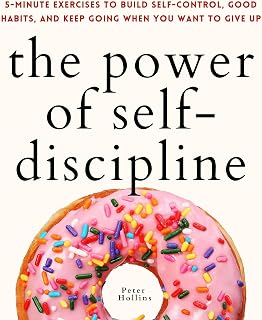
The Power of Self‑Discipline: 5‑Minute Exercises book by Peter Hollins offers quick, targeted exercises that build your discipline muscle without overwhelming you.
Step 7. Schedule Your Willpower
Your willpower fluctuates throughout the day. It’s highest in the morning after rest and lowest after decision overload. Schedule your most important tasks during your peak willpower hours.
If you’re a morning person, tackle your hardest task first. If you’re a night owl, protect that window. Align your action plan with your energy rhythms.
Common Obstacles to Self‑Discipline (and How to Beat Them)
Even with a solid plan, obstacles will pop up. Here are the most common and how to handle them:
| Obstacle | Solution |
|---|---|
| The “All‑or‑Nothing” Mindset | If you miss a day, just do one very small action. A 2‑minute workout counts. |
| Loss of Motivation | Revisit your “why” in writing. Attach emotional reasons to your goal. |
| Overwhelm | Break tasks into tiny steps. Focus on the next single action. |
| Instant Gratification Temptations | Use the 10‑minute rule: wait 10 minutes before giving in. The urge often passes. |
| Negative Self‑Talk | Replace “I can’t” with “I choose not to yet” or “I’m learning.” |
Best Books to Build Unbreakable Self‑Discipline
If you want a deeper dive, these books are top‑rated and highly practical.
| Book | Price | Rating | Get It |
|---|---|---|---|
| No Excuses! – Brian Tracy |
$8.66 | 4.7 | Buy at Amazon |
| Atomic Habits – James Clear |
$0.00 (Audible) | 4.8 | Buy at Amazon |
| Discipline Equals Freedom – Jocko Willink |
$12.93 | 4.7 | Buy at Amazon |
| The Mountain Is You – Brianna Wiest |
$0.00 (Audible) | 4.7 | Buy at Amazon |
| The Power of Self‑Discipline – Peter Hollins |
$0.00 (Audible) | 4.4 | Buy at Amazon |
Each of these books reinforces the core idea: how to be self discipline is a learnable skill. Pick the one that resonates with your current struggle and start reading.
Wrap‑Up: Your 30‑Day Challenge
Knowing how to be self discipline is useless without action. Take the next 30 days to implement the steps above.
- Week 1 – Pick one micro‑habit (e.g., 2‑minute meditation). Do it daily. No exceptions.
- Week 2 – Remove one major distraction from your environment (social media app, junk food in sight).
- Week 3 – Add an if‑then plan for a challenging situation.
- Week 4 – Review your progress. Celebrate the small wins. Adjust where needed.
You now have a brain‑friendly roadmap. The only thing left is to start. Remember: self‑discipline isn’t about being perfect. It’s about being consistent. And you can do that.
Frequently Asked Questions
Q: How long does it take to build self‑discipline?
A: Research suggests habits take an average of 66 days to become automatic, but you can see improvement in mental toughness within weeks of consistent practice.
Q: Can you learn self‑discipline as an adult?
A: Absolutely. Neuroplasticity means your brain can rewire at any age. Daily small acts of discipline strengthen the prefrontal cortex.
Q: What if I keep failing after a few days?
A: That’s normal. Failure is data, not a final verdict. Analyse what went wrong, adjust your environment or plan, and restart immediately.
Q: Is self‑discipline the same as willpower?
A: Willpower is a finite resource. Self‑discipline is the system you build so you rely less on willpower and more on routines and environment.
Q: Can self‑discipline help with procrastination?
A: Yes. The step‑by‑step plan directly addresses procrastination through small starts, friction removal, and accountability.