
When planning home upgrades, most people fixate on the sticker price. A new furnace costs $5,000. A smart thermostat runs $250. But that number alone tells you almost nothing about whether an upgrade is worth it. The real measure? Cost per saved dollar — how much you pay upfront for every dollar of long-term savings.
This metric flips the conventional wisdom. A cheap, low-quality upgrade can actually be more expensive in the long run if it saves little energy. Meanwhile, a higher-priced item may be a bargain when you divide its cost by the energy dollars it eliminates. Let’s break down how to calculate and apply this metric, then look at low-cost budgeting tools (like Wooden Money Saving Box) that help you fund the upgrades that truly pay off.
Table of Contents
Why Sticker Price Is a Trap
Imagine buying a $100 window sealant kit that saves you $20 a year in heating. Your cost per saved dollar is $5 (100 ÷ 20). Now consider a $500 attic insulation job that saves $150 annually — that’s $3.33 per saved dollar. The insulation has a higher sticker price, but it’s actually twice as efficient per dollar saved.
The trap is that most shoppers compare only upfront costs. They choose the cheaper option, then wonder why their utility bills barely budge. Cost per saved dollar forces you to consider both sides: what you spend and what you get back over time.
How to Calculate Cost Per Saved Dollar
The formula is straightforward:
Cost Per Saved Dollar = Total Installed Cost ÷ Estimated Annual Savings
- Total installed cost includes the product, labor, permits, and any ongoing maintenance.
- Estimated annual savings is the reduction in energy or water bills from the upgrade.
A lower number means better value. For example:
- LED bulb: Cost $3, saves $1.50/year → Cost per saved dollar = $2.00
- Weatherstripping: Cost $20, saves $15/year → Cost per saved dollar = $1.33
Once you have this number, you can compare upgrades across categories — even compare money-saving tools themselves (like envelope systems versus cash boxes) to see which gives the best “bang for your buck.”
Applying the Metric to Home Energy Upgrades
| Upgrade | Sticker Price | Annual Savings | Cost per Saved Dollar | Payback Years |
|---|---|---|---|---|
| Programmable thermostat | $35 | $50 | $0.70 | 0.7 |
| Attic insulation (R-38) | $1,200 | $300 | $4.00 | 4 |
| Energy Star refrigerator | $800 | $100 | $8.00 | 8 |
| Solar panels (5 kW) | $12,000 | $1,200 | $10.00 | 10 |
The thermostat has the best cost per saved dollar, even though its sticker price is low. The solar panels require a much bigger upfront outlay, but their cost per saved dollar is still reasonable over a 25-year lifespan. Always look at the ratio, not the absolute price.
Budgeting Tools to Help You Save for Upgrades
Before you can spend on energy efficiency, you need a system to accumulate cash. That’s where low-cost budgeting tools shine. Their own cost per saved dollar is astonishingly low — you pay a few dollars to help you save thousands.
Take the 100 Envelopes Money Saving Challenge at $8.99. It guides you to save $5,050 over 100 days. That’s a cost per saved dollar of $0.0018 — less than a penny. Compare that to a high-interest credit card that charges you 20% APR on the same amount. The envelope system is orders of magnitude cheaper.

For larger goals, consider the 10000 Kakeibo Wooden Money Saving Challenge Box at $7.99. It’s designed to hold $10,000 in preset increments. Your cost per saved dollar? Just $0.0008. No financial product — not even a high-yield savings account — can beat that ratio for building savings momentum.
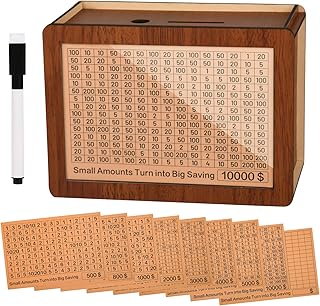
Top Low-Cost Savings Tools Compared
Here’s a quick comparison of the best-rated products from the data, each with their cost per saved dollar:
| Product | Price | Rating | Target Savings | Cost per Saved Dollar |
|---|---|---|---|---|
| Wooden Money Saving Box, Brown | $16.99 | 4.6 | $10,000 | $0.0017 |
| 100 Envelopes Challenge Binder (Black) | $8.99 | 4.7 | $5,050 | $0.0018 |
| 10000 Kakeibo Wooden Box | $7.99 | 4.4 | $10,000 | $0.0008 |
| Wooden Savings Box 12 Amounts | $7.99 | 4.5 | $10,000 | $0.0008 |
| NICOOTH 100 Envelopes Binder | $6.48 | 4.7 | $5,050 | $0.0013 |
All of these have a cost per saved dollar far below any typical home upgrade. Using them is like earning a 100,000% return on your initial investment — and the savings can then be directed toward the energy upgrade with the best long-term ratio.
How to Choose the Best Tool for Your Goals
- For a single, large goal (e.g., $10,000 for solar panels): Choose a wooden cash vault box like the KYODOLED Cash Box with Key Lock ($22.99) or a dedicated savings box. It physically constrains spending.
- For incremental, daily discipline: Envelope binders work best. The Sooez 100 Envelopes ($7.99) includes a tracker and encourages consistent deposits.
- For families or kids: A reusable wooden box with a dry-erase tracker (Wooden Savings Box 12 Amounts at $7.99) gamifies saving and teaches the value of delayed gratification.
- For portability: The SKYDUE Budget Binder ($8.98) combines envelopes with expense sheets, perfect for tracking both income and savings goals.
Each tool has a cost per saved dollar under $0.002. That’s orders of magnitude better than paying a financial advisor or using a personal loan with interest.
Final Thoughts: Upgrades That Pay for Themselves
When you compare upgrades by cost per saved dollar, you stop buying cheap junk and start investing in efficiency. A $20 weatherstrip kit that saves $15/year is better than a $1,200 window that saves $50/year. And a $7 savings box that helps you put away $10,000 is the best upgrade of all — it pays for itself 1,400 times over.
Start with a low-cost savings tool from the list above. Then use your accumulated cash to fund the home upgrade with the lowest cost per saved dollar. That’s how you build real wealth, one dollar at a time.
Frequently Asked Questions
What is cost per saved dollar?
It’s the total installed cost of an upgrade divided by the annual energy or money savings it generates. Lower numbers mean higher efficiency.
How does this compare to payback period?
Payback period (cost ÷ annual savings) is related but measures years to recoup investment. Cost per saved dollar normalizes the value regardless of lifespan. Both are useful, but cost per saved dollar better compares upgrades with different lifetimes.
Can a savings box really help me afford home upgrades?
Absolutely. These physical tools create a tangible savings habit. With a cost of $6–$17 and potential savings of $5,000–$10,000, their return on investment is enormous — often over 100,000%.
What is the best home upgrade by cost per saved dollar?
Programmable thermostats and weatherstripping often lead the pack. But always calculate your specific savings using your local energy rates and home size.